A guide to a cost-effective SIS

Bridging the gap between safety compliance and efficient deployment.
Talk to process engineers and a common frustration quickly emerges around implementing Safety Instrumented Systems (SIS): many plants need certified safety coverage or a logic solver for just a handful of loops, such as an overpressure interlock, pump shutdown or high-temperature trip. Yet the available options are often mismatched to the need. On one end is a basic alarm device for a single function or loop that falls just short of requirements; on the other, you have a full safety PLC that meets the requirements but comes at a cost far beyond what the application justifies. This in-between space, commonly referred to as the ‘safety gap’, is where much of the real-world SIS work resides, and it has remained underserved for years.
The challenge with defaulting to a safety PLC
Specifying a safety PLC for a small SIF (Safety Instrumented Function) is technically defensible under IEC 61511. No one’s going to argue that it is incapable, but in practice, it often creates headaches that outlast the original project. Oftentimes, you are buying more equipment than you need. With these larger, more complex safety logic solvers, you are locked into licensed programming software and complex architectures, where even minor logic changes often require waiting on a certified specialist. This leaves many plants with safety systems that are costly to commission, difficult to modify, and more complex than the application truly demands.
A better fit: multi-loop logic solvers
When point and loop counts are smaller, or when safety loops are not centralised, users should consider installing a logic solver that handles more than one loop but has some of the advanced functionality of the larger safety PLCs. The Moore Industries SLA Multifunctional Safety Logic Solver and Alarm sits squarely in the safety gap. It is exida certified to IEC 61508:2010 with systematic integrity to SIL 3, random integrity to SIL 2, but packaged more like a field instrument than a control system. With up to six analog inputs, 16 internal alarms, and eight physical alarm outputs, simple and complex alarming strategies can be implemented with easy-to-use dropdown menus, radio buttons and check boxes. Even complex alarm voting architectures like 1oo2, 2oo3 and 3oo5 are simple to employ.
Integration with existing control and monitoring systems is straightforward as the SLA supports Modbus/TCP and Modbus RTU industrial protocols. An embedded read-only web server also allows all inputs, outputs, internal variables and various other parameters to be read with a simple web browser.
Configuration without complexity
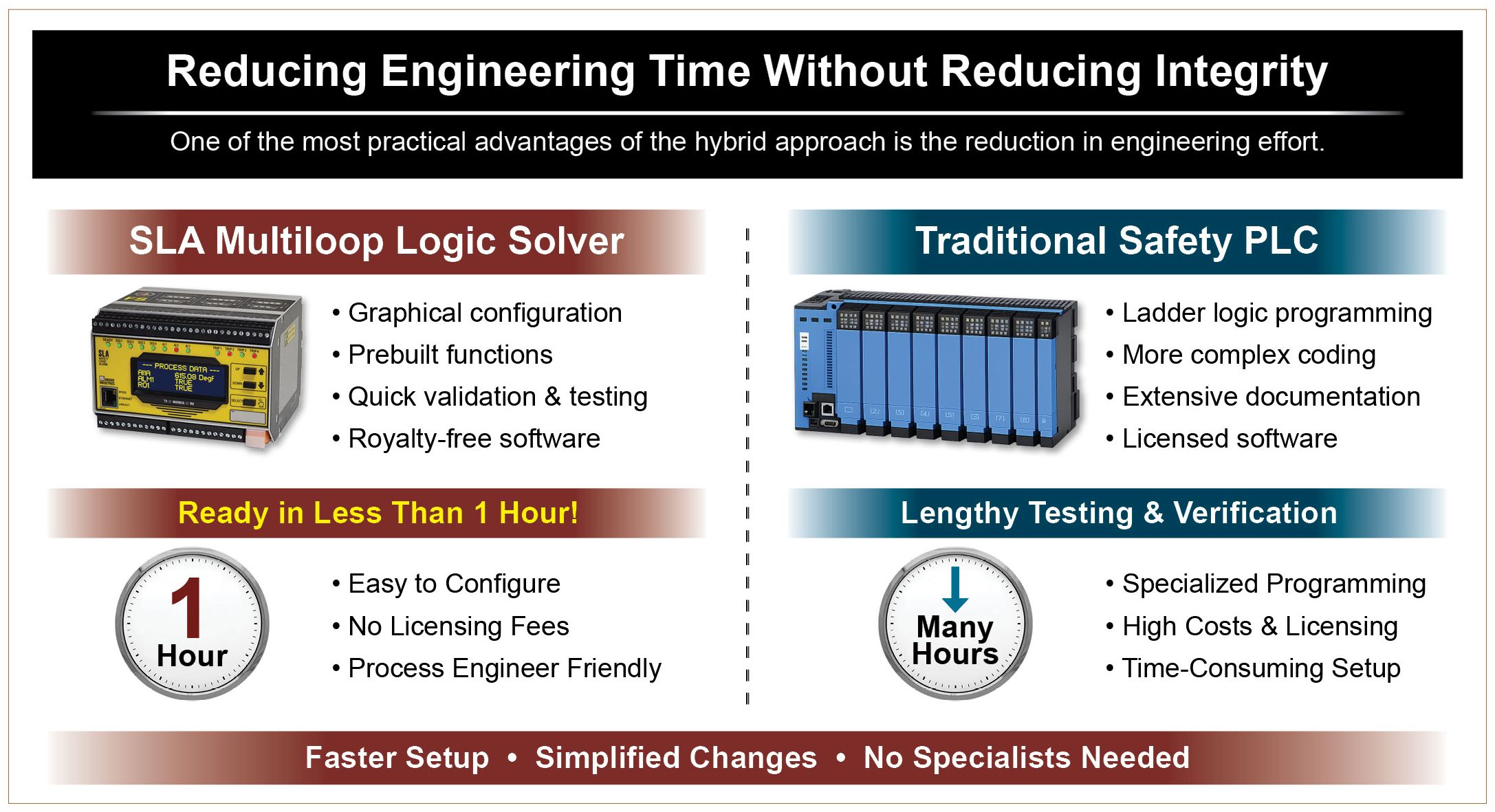
Setting up an SLA-based safety function is secure, straightforward and hassle-free. No custom or licensed software is required with the SLA, as it is programmed with any FDT-compliant host, such as PACTware. Along with configuration and setup, the SLA’s DTM also includes full monitoring and simulation capabilities that allow users to test alarming and safety functions before installation or commissioning. For more advanced safety functions, the SLA’s powerful but easy-to-use equation/expression editor enables the creation of monitoring, alarming and control schemes that involve simple to complex equations using timers, running min/max functions, prebuilt analog and discrete logic functions, and more.
This means process engineers can more easily own the safety function from commissioning through future modifications, removing a common bottleneck on sites where certified safety PLC specialists are sometimes in short supply.
Getting the size right
The push for functional safety compliance has produced better outcomes across process industries, but it has also driven some unnecessary spending. For small SIS applications, a right-sized solution can often deliver the same certified protection at a fraction of the cost and engineering overhead. The Moore Industries SLA isn’t intended to replace a safety PLC where one is truly required. But for the many applications that fall into the safety gap, it delivers what the market has long lacked: a certified, practical, field-ready solution that keeps you compliant without forcing unnecessary complexity or cost.
Overpressure protection in critical systems: the role of rupture discs in preventing costly downtime
In industrial processing environments, pressure is both a necessity and a risk.
The missing middle: Solving the logic solver gap in SIS design
Why safety professionals need a new class of logic solver; one that bridges the enormous gap...
The Machinery Regulation will be mandatory in less than a year — are you ready?
The EU Machinery Regulation and the Cyber Resilience Act will reshape how manufacturers and...