How flow meters improve the performance of your dosing pumps
A pilot plant is an important step from lab-scale to commercial-scale production.
In the chemical industry, it is common to build pilot plants to minimise risks in the final plant, especially in advanced chemicals. In this ‘step-in-between’ it is essential to measure the critical fluids very accurately to draw the right conclusions in time.
Dosing pumps are often used in pilot plants to control the liquid flows, but accurate, fast and efficient data on liquid flows is the key to success.
Based on market research and analysis, it became clear to us that customers from the chemical industry can use either industrial flow meters or laboratory flow meters in their pilot plants. Both are not ideal. For the Bronkhorst product management team, this insight was their starting point. Thanks to the hard work of their technical colleagues, they have been able to develop a flow meter that is specifically suitable for pilot plants. But first let’s start with analysing the situation.
Accurate, fast and efficient data for pilot plants is a need
When measuring critical fluids, the amount of highly accurate data — which is needed to make the right decisions for the final plant — need to be collected accurately and efficiently. If fluids cannot be measured accurately enough, tests must run for a very long time to finally collect the required data to build decisions on. Pilot plant tests usually cost a lot of money, especially when a long testing time is involved. However, when the system is equipped with accurate instrumentation, the test duration can be shortened dramatically.
Dosing of fluids: using a dosing pump
There are several solutions to choose from when dosing fluids in a process. Many users choose a volume-based dosing pump. A dosing pump is a typical solution to dose a certain amount of fluid into a process. This volume-based approach is good enough for non-critical processes. But if the process is critical, the operator needs to be sure that the dosing pump is dosing the correct amount. Dosing pumps cannot check themselves. Especially if there is a leak, a changing backpressure or a contaminated pump chamber occurs, the indicated flow is no longer reliable. This is the point where an accurate flow meter can close the gap.
Pump control: using a dosing pump with flow meter
If you decide to integrate a flow meter in your process as well, the flow created by a dosing pump (or metering pump) can be measured and corrected. The flow meter measures the mass flow and the measured value is used to correct the dosing pump directly. So, a flow meter with (external or internal) controller functionality converts the dosing pump into an advanced closed-loop dosing system, and this is how a dosing pump finally becomes part of an accurate dosing solution.
Using a mass flow meter for pump control in a pilot plant
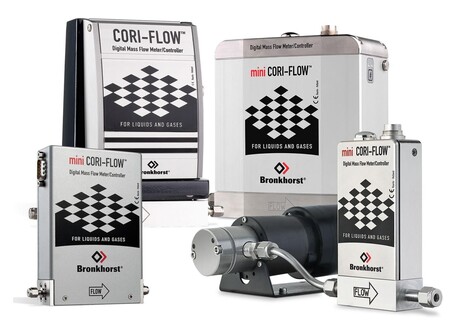
But which type of flow meter should you choose to use in your pilot plant? As a dosing pump only measures the volume mechanically — and the volume of a fluid can be influenced by many parameters — a mass flow meter would be the preferred choice. It compensates for the weaknesses of the dosing pump. A Coriolis mass flow meter measures accurately and independently of fluid properties, so if you combine a dosing pump with a Coriolis mass flow meter, you get a very reliable and accurate dosing system.
Accuracy, dimensions and robustness of the flow meter
Many types of Coriolis mass flow meters are available on the market, but can all of these be a perfect fit? In many cases, the application is special in one way or another. As previously mentioned, in pilot plants several things come together. That is why the following three details are particularly important to consider when you select your Coriolis mass flow meter.
1. In laboratory applications
The flow meter should perform very accurately to enable scientists to find the real truth.
Specifications from manufacturers are sometimes difficult to achieve in practice, which is why we recommend you perform a test to measure the practical performance of such a flow meter. The written performance is not always the same as in practice.
2. In industrial applications
Reliability and robustness are usually the most important factors in industrial applications. But this can come at the expense of other specifications, such as accuracy. While reliability and robustness are important, truth-finding is more important in a pilot plant, as in the lab.
3. In pilot plant applications
There is another important point that requires attention, namely the dimensions of all components in a pilot plant. Size matters, especially concerning pilot plants that are more compactly built. Most typical industrial Coriolis flow meters bring a serious amount of space and weight into the equation. Therefore, the skid or entire system must be scaled up significantly, which introduces the necessary costs and system inertia.
Next-generation in-line pH measurement for improved process control
The METTLER TOLEDO InPro X1 SLS provides a new option for reliable, glass-free...
Weigh smarter with METTLER TOLEDO's IO-Link
Accurate weight measurement is critical in automated systems, impacting everything from batching...
The vegetable oil refining process
Monitoring oil refining processes in real time can be greatly improved with the use of optek...