Ensuring reliable level measurement in tanks with internal obstructions
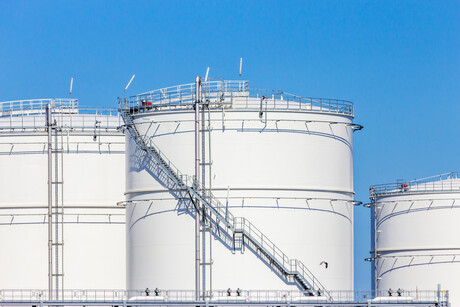
High-frequency radar level transmitters with narrow beam angles can reduce the risk of interference in obstructed tanks, but they can’t always avoid it.
Accurate and reliable level measurement is fundamental to the safe and efficient operation of process plants. Level data underpins effective process control, optimised inventory management and precise custody transfer — all of which directly influence productivity and profitability. In addition, level measurement is central to critical safety applications such as overfill prevention. A broad range of level measurement technologies is available to end users, including differential pressure, capacitance and guided wave radar. Each technology has proven effective in specific conditions, but non-contacting radar transmitters based on frequency modulated continuous wave (FMCW) technology have emerged as a preferred choice for numerous applications.
Non-contacting radar level transmitters provide a direct, top-down measurement that is extremely accurate and reliable, and with no moving parts these devices have minimal maintenance requirements. Because the antenna does not come into contact with the process medium, issues such as coating, corrosion and mechanical wear are eliminated or greatly reduced. This makes the technology particularly well-suited to aggressive chemicals, sticky or viscous products, as well as hygienic applications where material contact must be avoided. Radar measurement requires no compensation for variations in density, dielectric constant or conductivity, and modern FMCW transmitters can maintain high accuracy in extreme pressures and temperatures. Because this versatile technology is suitable for measuring the level of liquids, sludges, slurries and bulk solids, it has been widely adopted across industries including oil and gas, chemical, refining, food and beverage, water and wastewater, and life sciences.
Principle of operation
Non-contacting radar level measurement is based on the transmission and reflection of microwave signals. FMCW devices transmit a continuous microwave signal, the frequency of which is constantly varied across a defined range. When the reflected signal (known as an echo) returns from the product surface, it is compared with the frequency of the signal being transmitted at that moment. The difference between the two is directly proportional to the distance to the surface.
Challenges posed by internal tank obstructions
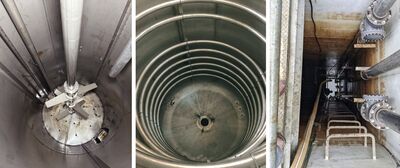
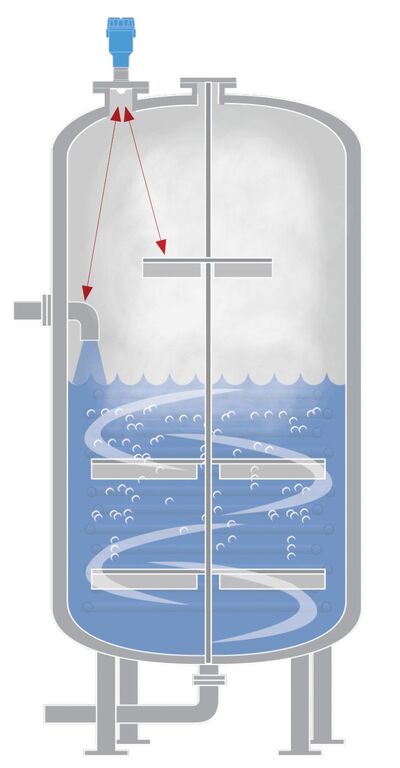
The product surface is, however, not the only feature within a tank that reflects microwave signals. Tanks often contain a range of internal structures such as ladders, agitators, heating or cooling coils, baffles and nozzles, which can also reflect signals, producing false echoes that compete with the true surface echo. The transmitter must then distinguish between multiple possible echoes to identify which one accurately represents the product surface.
This task becomes especially challenging when measuring products with a low dielectric constant, such as certain hydrocarbons, liquefied gases or oils. Because these materials reflect radar signals weakly, the true surface echo may be less distinct than the echoes generated by obstructions. As a result, even minor interference from internal structures can cause the transmitter to misidentify a false echo as the correct one. The presence of turbulence, foam or vapours can further complicate the situation, as these conditions may weaken the surface echo or introduce additional sources of signal scattering. When combined, these factors can make accurate and reliable level measurement in obstructed tanks one of the most difficult applications for non-contacting radar technology.
The consequences of interpreting a false echo as valid
When a transmitter misinterprets a false echo as the true product surface, the result is an inaccurate level measurement. The consequences of such an error can be wide-ranging, and in many cases extremely serious. The most critical risk is overfilling the tank. If the transmitter reports the level as lower than it actually is, a tank may be filled beyond its capacity. This can lead to product spillage, which in the case of volatile or flammable substances poses immediate safety hazards to personnel, as well as the risk of fire or explosion. Even when the product itself is not hazardous, spills can cause environmental damage, and lead to regulatory non-compliance and significant financial costs associated with clean-up and product loss.
Conversely, a false echo may cause the transmitter to indicate a level higher than reality, leading to premature filling stops. Underfilled tanks reduce storage efficiency, disrupt production schedules, and can result in downstream process interruptions, product shortages or even dry running of pumps, which may cause equipment damage and unplanned downtime. Across industries that depend on just-in-time operations, such inefficiencies can translate directly into lost revenue and reduced competitiveness.
False echoes can also degrade process quality and efficiency. In batch operations that rely on precise volume control, inaccurate level measurements may lead to inconsistent product quality, rework or waste. Ultimately, the misinterpretation of a false echo compromises not only safety, but also operational efficiency, product quality and profitability. This makes effective discrimination between true and false echoes a critical requirement for reliable non-contacting radar level measurement.
Strategies for mitigating false echoes
While tanks containing internal structures present clear challenges for non-contacting radar level transmitters, a number of strategies can help to reduce or eliminate the impact of false echoes. The most fundamental consideration is the placement of the radar device. If a tank has an existing nozzle that provides a completely unobstructed line of sight to the product surface, installing the transmitter there is the most straightforward and effective solution. Proper positioning minimises the likelihood of echoes being generated by internal structures and helps to ensure that the strongest signal received corresponds to the actual product surface.
In practice, however, it is uncommon for a nozzle to be located in an ideal position. Tank openings are often dictated by mechanical design, process requirements or structural constraints rather than by measurement considerations.
As a result, many installations cannot avoid at least some degree of obstruction within the radar beam path. In these cases, additional measures become necessary to achieve accurate and reliable measurements.
Deflector plates
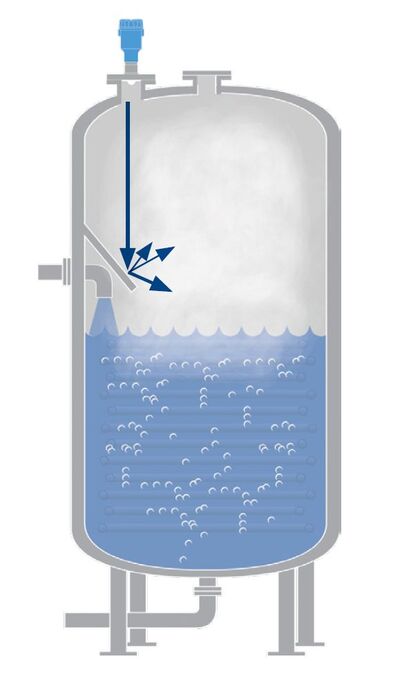
In tanks with internal structures, some radar level transmitter vendors recommend the use of deflector plates to reduce the impact of false echoes. These plates are typically installed near obstructions and angled to redirect radar waves that would otherwise reflect directly back to the transmitter. By guiding unwanted reflections towards tank walls or other areas where they dissipate, deflector plates help the transmitter to more reliably identify the true material surface, resulting in more stable and consistent level measurements.
However, while deflector plates can improve measurement reliability in some applications, their installation presents several practical challenges. In tanks with limited access or complex internal structures, positioning the plates correctly can be difficult. Misaligned plates may inadvertently create additional reflections or partially block the radar beam, producing blind spots or signal loss. More importantly, no end user is likely to go through the expense and inconvenience of securing confined-space entry permits and deploying welders inside a vessel merely because an internal obstruction might cause a measurement issue. Such interventions represent significant operational disruption and cost, and are rarely justified unless a proven and recurring problem exists. Operational conditions also affect performance. In tanks containing sticky, viscous or dusty materials, build-up on deflector plates can change the angle of reflection or generate new false echoes, potentially compromising measurement accuracy.
False echo suppression
For many years, top-down level measurement technologies have used a common mapping technique to analyse received signals and suppress false echoes, ensuring that the device reliably detects the true material level. During initial commissioning, a reference map of the tank is created by capturing echoes when the tank is empty or at a known level. These stored signals represent potential false echoes from fixed obstructions and serve as a baseline for comparison during normal operation. As the transmitter operates, incoming echoes are continuously evaluated against this reference map. Signals corresponding to known obstructions are identified and effectively ignored, while changes in the echo profile indicate movement of the actual product surface. This enables accurate, continuous level measurement, even in tanks with complex internal geometries.
In practice, however, there are two fundamental limitations to conventional false echo suppression. Firstly, the need to empty a tank in order to map echoes is often impractical, as this can interrupt operations and add downtime that many facilities cannot easily justify. Secondly, false echo suppression relies on the transmitter establishing a fixed threshold to block unwanted echoes based on conditions observed at the time of set-up. However, echo amplitudes can fluctuate over time due to process changes, temperature variations, or other environmental influences. If a previously suppressed false echo later increases in strength and exceeds the stored threshold, it can reappear in the measurement signal — sometimes unexpectedly — leading to intermittent or misleading level readings. These factors highlight why, despite their usefulness, traditional false echo suppression methods are not foolproof.
Smart echo supervision
More recently the introduction of smart echo supervision has enabled organisations to achieve more accurate, reliable measurements in tanks with internal obstructions — and without the need for installing deflector plates or running complex false echo suppression algorithms.
At the heart of smart echo supervision is a dynamic evaluation of all viable echoes. The system continuously analyses the behaviour of each echo in real time, ranking them according to how closely they resemble the behaviour of a true material surface reflection over time. The echo that most consistently mirrors the dynamics of the surface is automatically tracked as the genuine surface echo, while stationary or irrelevant echoes — typically originating from tank obstructions — are automatically suppressed.
This adaptive approach allows the transmitter to maintain accurate readings even as the echo profile changes due to rising or falling levels, tank agitation, temperature variations, or the presence of vapour or foam. By continuously adapting to these environmental changes, smart echo supervision aims to ensure stable, repeatable performance without the need for frequent manual recalibration or intervention. On those occasions when manual adjustment is required, a user interface can enable operators to suppress unwanted echoes. This simplicity reduces commissioning time and minimises the potential for human error.
By combining intelligent echo evaluation and real-time adaptation, smart echo supervision makes it possible to confidently measure tank levels in even the most obstructed and complex vessels, while simplifying installation, commissioning and ongoing operation.
Conclusion
While today’s high-frequency non-contacting radar transmitters with narrow beam angles can reduce the risk of interference in obstructed tanks, true measurement reliability is only achieved when they are paired with advanced signal processing. Smart echo supervision is the latest technology that provides this capability, providing a solution that is specifically engineered to address the complexities of tank environments.
By continuously analysing and ranking all viable echoes, filtering out false signals and adapting dynamically to changing process conditions, the technology ensures that the genuine surface echo is consistently identified and tracked. The result is a more stable, accurate and dependable level measurement.
From Dark Age to Imperial: what Age of Empires teaches us about instrumentation
Ultimately, performance is not defined by the sophistication of technology alone, but by how and...
Five common mistakes in industrial temperature monitoring
In industrial production, effective temperature and humidity monitoring is more than just...
Video-based water detection reduces contamination in gas pipeline
How a US midstream company improved gas quality and reduced operating costs.