Video-based water detection reduces contamination in gas pipeline
One of North America’s largest midstream operators manages an extensive natural gas transmission network. In late 2024, the company initiated a LineVu Discovery study at a custody transfer point to better understand the presence of liquid carryover in its incoming gas supply.
The results were striking. Despite reported hydrocarbon dewpoints (HCDP) as low as -47°C, significant liquid contamination was observed inside the pipeline. As a result of the contamination, the midstream operator faced rising operational costs due to frequent pigging, disposal costs, compressor servicing, and instrumentation failures. Despite challenging suppliers regarding gas quality, traditional measurements for both moisture and hydrocarbons (following API 14.1 for gas sampling and frequent calibrations) indicated that the gas was dry. The company needed an indisputable, real-time method to determine gas quality and detect liquids present in gas streams entering the transmission network.
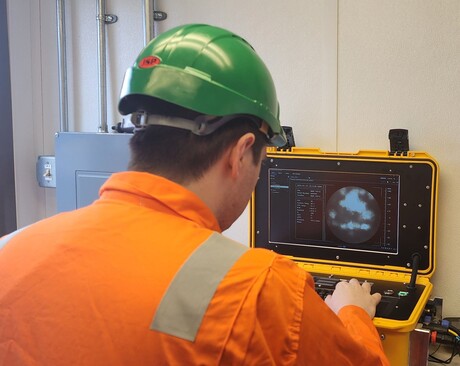
The organisation therefore deployed Process Vision’s LineVu high-resolution process cameras at custody transfer points. Certified for hazardous areas (Class 1 Div 1 and ATEX Zone 1), these cameras provide continuous, real-time video of the gas stream via an online dashboard, enabling managers and remote engineers to see mist and liquid flows that conventional analysers miss.
In some cases, video data was synchronised with process data, revealing links between the onset of mist flow and changes in energy content and other parameters. Process Vision has developed smart alarms that alert operators when abnormal conditions arise, enabling swift, targeted interventions to reduce pigging costs and compressor damage.
In order to reduce risks caused by liquid carryover, the operator established a ‘three strike’ policy for all gas suppliers.
- Strike 1: If a mobile LineVu Discovery system detects liquids at a custody transfer point, suppliers receive the results and are given 30 days to rectify the problem.
- Strike 2: A second detection within six months triggers an additional 30-day remediation period.
-
Strike 3: On a third occurrence, the supplier is required to permanently install a LineVu system to monitor and manage gas quality continuously.
Early results showed that HCDP alone is not a sufficiently reliable method to determine if a gas stream is wet or dry. With LineVu, the operator expects significant operational and safety improvements. In the short term, lower pigging frequency, reduced compression costs, and lower erosion of valves and regulators are expected. In the long term, there should be fewer compressor trips, less servicing costs and an extension of asset life.
LineVu has been shown to provide significant benefits for both suppliers and transmission system operators (TSOs). For suppliers, even a small liquid volume fraction (0.1%) in a 100 MMSCFD export line at 1000 psi equates to more than 2831 litres/day, boosting annual NGL revenue significantly. For TSOs, catching liquids early prevents compressor trips (often costing around US$600,000 per occurrence), reduces pigging costs (up to US$22,000 per km) and extends compressor dry-gas seal life from approximately one year to more than three years.
After validating the effectiveness of LineVu, the midstream company has standardised the use of LineVu Discovery studies across its transmission network, ensuring consistent monitoring, transparent supplier accountability and proactive protection of downstream assets.
Phone: 03 9017 8225
Rosemount 350A digital pH/ORP sensor
The Rosemount 350A pH/ORP sensor is designed for harsh processes and simplifies installation and...
WIKA ILT radar sensor
The ILT radar sensor is a compact, free-beam sensor that enables non-contact level measurement,...
ABB NINVA non-invasive temperature instruments
The NINVA Integrated, NINVA Remote and NINVA Compact non-invasive temperature instrumentss are...