UNSW hydrogen fuel cell design could unlock key clean energy technology
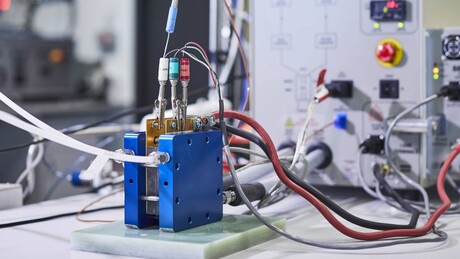
Researchers at the University of NSW have redesigned hydrogen fuel cells to solve a critical flaw, bringing clean energy for aviation, heavy transport and beyond closer to reality.
Hydrogen fuel cells, using locally produced green hydrogen as the only fuel, have long been viewed as the ultimate clean energy source. In theory, they could deliver cheap, abundant clean energy — transforming industries like freight and aviation that batteries struggle to power. But translating that promise into real-world emissions cuts has proven difficult.
A multidisciplinary team from UNSW, led by Dr Quentin Meyer and Professor Chuan Zhao from the School of Chemistry, has managed to make hydrogen fuel cells much more efficient, paving the way for their commercialisation.
“Hydrogen fuel cells generate clean electricity with water as the only by-product,” said Meyer, first author of the research published in the journal Applied Catalysis B: Environment and Energy.
Some of the water produced inside the cell gets trapped, blocking the flow of oxygen and choking performance. Fixing that typically requires complex, energy-intensive systems that add cost and weight.
The UNSW team’s new design takes a different approach: it allows excess water and gas to escape before they can build up, without adding to the cost.
“Our design can make hydrogen fuel cells much more efficient with only minor structural changes,” Meyer said.
A brand new design
The UNSW team’s solution focuses on the structure of the fuel cell itself. Using high-precision micro-scale engineering, they introduced microscopic channels — 100 micrometres wide, separated by 100-micrometre micro-ribs — into the internal architecture of the cell.
“There’s usually no way to remove water,” Meyer said. “But these ‘lateral bypasses’ act as escape routes, meaning water no longer accumulates and stops the cell working.”
It’s a simple fix with a substantial impact.
“The redesigned fuel cell achieves 75% more power than traditional designs,” he said.
“We’re rethinking hydrogen fuel cells in Australia by combining advanced imaging, fluid flow simulations and precision micro-engineering,” said Professor Peyman Mostaghimi from the UNSW School of Civil and Environmental Engineering, and Dr Ying Da Wang from the UNSW School of Minerals and Energy Resources Engineering.
The result is a far more efficient system, making fuel cells more attractive for mass markets.
“It’s very exciting,” Zhao said. “This breakthrough could be used in a range of different settings and brings cheap, clean and abundant hydrogen energy to within our reach.”
Real-world applications
The new design is also less reliant on costly metals like platinum, and the overall system is lighter and cheaper.
The current fuel crisis has highlighted the need for such clean energy solutions, the team says, particularly in aviation and freight.
“I believe aeroplanes will be powered by hydrogen fuel cells in the very near future,” Meyer said.
“By redesigning hydrogen fuel cells, lightweight aviation becomes a lot more realistic,” Zhao added.
Closer to market, the team is targeting low-altitude aircraft, where hydrogen systems can already deliver significantly longer flight times than battery alternatives.
The lateral bypass technology has been patented by Meyer and Zhao, and they are now working to scale it.
NeoSmelt joins HILT CRC in low-emissions ironmaking research
NeoSmelt is investigating the development of a direct reduced iron electric smelting furnace...
Former mine site at Teralba to be new train manufacturing hub
The NSW Government has announced a former mine site at Teralba as the preferred location for a...
Weld Australia joins Additive Manufacturing CRC
New partnership will connect Australia's welding industry with a $57.5m national research...