The environmental impact of AI: a help or hindrance for industry?

AI offers powerful tools to improve sustainability in water, waste and energy systems, but its own energy, water and infrastructure demands pose significant environmental trade-offs.
Artificial intelligence (AI) is often framed as a technological silver bullet — able to squeeze inefficiency out of supply chains, predict failures before they happen and optimise scarce resources. Yet the same AI systems driving those improvements are themselves energy-intensive, thirsty for water (for cooling), and dependent on materials-heavy infrastructure.
For industries wrestling with sustainability challenges in water, waste and energy, the real question is not whether AI can help, but whether it will be deployed in ways that reduce net environmental harm.
Where AI helps: precision, prevention and systems thinking
First of all, we should consider how AI can help optimise environmental sustainability in various industries.
Among the strongest arguments for the use of AI are:
- detailed sensing and prediction
- fast optimisation of complex systems
- automation that reduces human error and labour costs for repetitive, hazardous tasks.
Some examples of these capabilities have already found use cases in water, waste and energy-related systems.
Water and wastewater
Machine learning models coupled with IoT sensors can predict demand, detect leaks and optimise pumping schedules — all of which reduce unnecessary water withdrawals and energy used to move water.
In agriculture, AI-driven irrigation systems determine when and how much to water based on soil moisture, weather forecasts and crop models, cutting consumption while protecting yields.
Waste
Automated sorting systems powered by computer vision and robotics improve recycling rates: AI-powered sorting robots are capable of sorting up to 1000 items per hour, compared with humans who generally manage 80–100 items per hour.
AI can also assist by identifying and separating materials more accurately than manual sorting — reducing contamination that places limits on the success of recycling.
Energy
AI excels at forecasting renewable generation and demand, enabling smarter grid balancing, battery dispatch and demand response. This is one area where AI can have the greatest impact: taking into account numerous factors to optimise the electricity grid as load and other conditions change throughout the day.
Machine learning controllers in industrial energy management systems (EMS) can also be used to squeeze more useful work from the same inputs, cutting both energy consumption and emissions.
The problem with AI is its own resource footprint
Notwithstanding AI’s great potential in assisting with environmental sustainability, the sheer power of the computing infrastructure required to drive AI is pushing energy grids and challenging water resources in many parts of the world.
According to an Australian Government committee of enquiry in 2024, the “environmental impacts of artificial intelligence (AI) are significant and arise across the AI lifecycle, from the development and training of AI models; the deployment of AI systems for various uses in industry, business and society; and the building, decommissioning and renewal of the Information Technology (IT) infrastructure and equipment that support and comprise AI technology.”1
Training and running large AI models requires vast computing resources, which consume electricity and produce greenhouse gas emissions depending on the electricity’s carbon intensity. Hyperscale data centres — the backbone of modern AI — also use significant water for cooling, sometimes in water-stressed regions. These infrastructure impacts introduce trade-offs: deploying AI to save energy in a factory (for example) could still increase net emissions if the compute and cooling footprint is large and powered by fossil fuels.
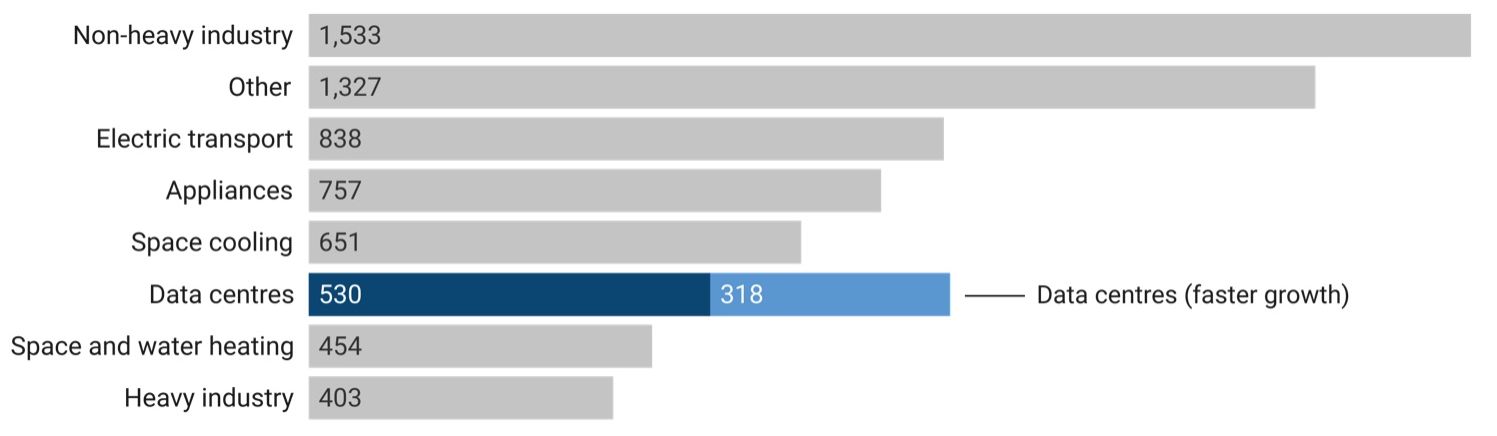
The global electricity consumption of data centres has grown by around 12% each year since 2017, according to the IEA, and companies such as Google, Meta and Microsoft have reported large emissions spikes over the past few years due to data-centre expansion, despite their net-zero pledges.
One thing is certain: although data centres currently account for around 1% of electricity consumption and around 0.5% of global carbon emissions at present, the International Energy Agency has predicted2 that they will be the fastest growing consumers of electricity from now until 2030 (Figure 1).

The latest news: Google and Microsoft chasing nuclear energy
To counter the energy sustainability problem, and knowing the extent of the growing need for energy, tech giants Google and Microsoft recently announced that they will invest in the reopening of mothballed nuclear power plants in the US to feed their ever-growing energy needs.4
Google has announced a plan with NextEra Energy to restart the Duane Arnold Energy Center in Iowa, a nuclear power plant that closed in 2020. The company has signed a 25-year power-purchase agreement (PPA) to secure electricity for its expanding network of data centres. Meanwhile, Microsoft has partnered with the famous Three Mile Island Nuclear Generating Station in Pennsylvania — which was shut down in 2019 — under a new name, the Crane Clean Energy Center.
For countries such as the US that already have established nuclear energy infrastructure this may seem an obvious solution, but for countries such as Australia, the drive to renewable energy becomes even more important in sustaining AI infrastructure growth.
In August, Treasurer Jim Chalmers announced that the development of data centres was in the national interest, and others have suggested that Australia could become a ‘sustainable AI hub’ for the Asia–Pacific. However, the power-hungry nature of data centres poses major problems for the current energy grid in Australia, and is seen as one of the reasons for the slight downgrade of Australia’s climate target to a 62–70% cut in carbon emissions below 2005 levels by 2035 — slightly below the previous target of 65–75%.5
Net impact: the context matters
Whether AI is a net help or hindrance depends on context and design choices:
- Energy sources: AI powered by grids dominated by renewables has far lower lifecycle emissions. In Australia, this reveals a problem: of the current 274 data centres in Australia, 149 are in Sydney and Melbourne: in the states with the least percentage of renewable energy generation.6
- Model size and usage pattern: Smaller, efficient models carry far lower overhead than massive generative models. For individual organisations such as manufacturing sites, utilising their own smaller, business-specific AI models is both more reliable and trustworthy in the context of the business, and consumes far fewer resources than general-purpose AI infrastructure.
- Size of the benefit: If AI reduces industrial energy use by 10–30%, the saving can outweigh the compute footprint, especially when smaller private models are used.
- Location and water stress: Placing data-intensive infrastructure in water-scarce regions can create local sustainability crises. As the driest continent on Earth, this is an issue that Australia will also have to deal with at some stage in the near future, but there appears to have been far less discussion of this issue than of electricity consumption.
A balanced conclusion: AI is here to stay
It is now too late to be worrying about how AI may affect environmental sustainability — the AI juggernaut appears to be unstoppable already. However, the technology itself can offer tools to cut water consumption, raise recycling yields and improve energy system flexibility — all vital for sustainable industry and a sustainable grid.
While the environmental costs of training and operating large models are real, growing and unevenly distributed, the net outcome will be determined by choices: model architecture, where compute happens, which energy sources are used for power and whether industries commit to measuring and offsetting the full footprint.
For industry leaders, the pragmatic path is clear: harness AI where it delivers measurable resource savings, design deployments to minimise computation and water intensity, and push for clean energy and smarter cooling at the infrastructure level.
1. Australian Parliament 2024, Select Committee on Adopting Artificial Intelligence (AI): Final Report, Chapter 6: Impacts of AI on the environment, <<https://www.aph.gov.au/Parliamentary_Business/Committees/Senate/Adopting_Artificial_Intelligence_AI/AdoptingAI/Report/Chapter_6_-_Impacts_of_AI_on_the_environment>>
2. International Energy Agency 2025, ‘Energy and AI’, <<https://iea.blob.core.windows.net/assets/601eaec9-ba91-4623-819b-4ded331ec9e8/EnergyandAI.pdf>>
3. Gabbatis J 2025, ‘AI: Five charts that put data-centre energy use – and emissions – into context’, CarbonBrief.org, <<https://www.carbonbrief.org/ai-five-charts-that-put-data-centre-energy-use-and-emissions-into-context/>>
4. Australian Business Journal 2025, ‘Google and Microsoft Turn to Nuclear Power for AI Energy Needs’, 29 October 2025,<<https://theabj.com.au/2025/10/27/google-microsoft-nuclear-power-ai/>>
5. The Conversation 2025, ‘Power-hungry data centres threaten Australia’s energy grid. Here are 3 steps to make them more efficient’, <<https://theconversation.com/power-hungry-data-centres-threaten-australias-energy-grid-here-are-3-steps-to-make-them-more-efficient-266992>>
6. Data Center Map 2025, ‘Australian Data Centers’, <<https://www.datacentermap.com/australia/>>
The next era of generative AI in industry
Exploring developments in generative industrial AI and their implications for industry.
4 common causes of rotating asset failure and how to prevent them
Preventing failure of rotating assets with predictive maintenance using condition-monitoring...
Critical industries need to know how to isolate, rather than ignore
It is time for critical infrastructure organisations to act on ASD's warnings about...