The accelerating decline of fieldbus as Ethernet takes over

HMS Networks has released its annual analysis of the industrial network market, tracking how factories and machine builders connect their automation systems.
The long-running shift from traditional fieldbus technologies to industrial Ethernet has continued through another full year according to HMS Industrial Networks’ annual study of the industrial network market.
The HMS Networks analysis is now in its 12th year, and is based on a combination of market insights, internal data, and input from key stakeholders in the industrial automation industry. The study focuses on newly installed nodes in factory automation worldwide, each node being a device or machine connected to an industrial control network.
After the slowdown of 2024, the market stabilised over the last year. Component availability has returned to normal levels and inventory cycles in highly automated sectors have largely been worked through. While Europe’s automotive sector continued to face headwinds, broader manufacturing activity recovered modestly, and capital spending on new automation projects resumed in most regions. The 2026 study confirms HMS Networks’ expectation of approximately 7.7% average annual growth in newly installed nodes over the next five years, with continued migration of the remaining fieldbus install base to industrial Ethernet driving much of that expansion.
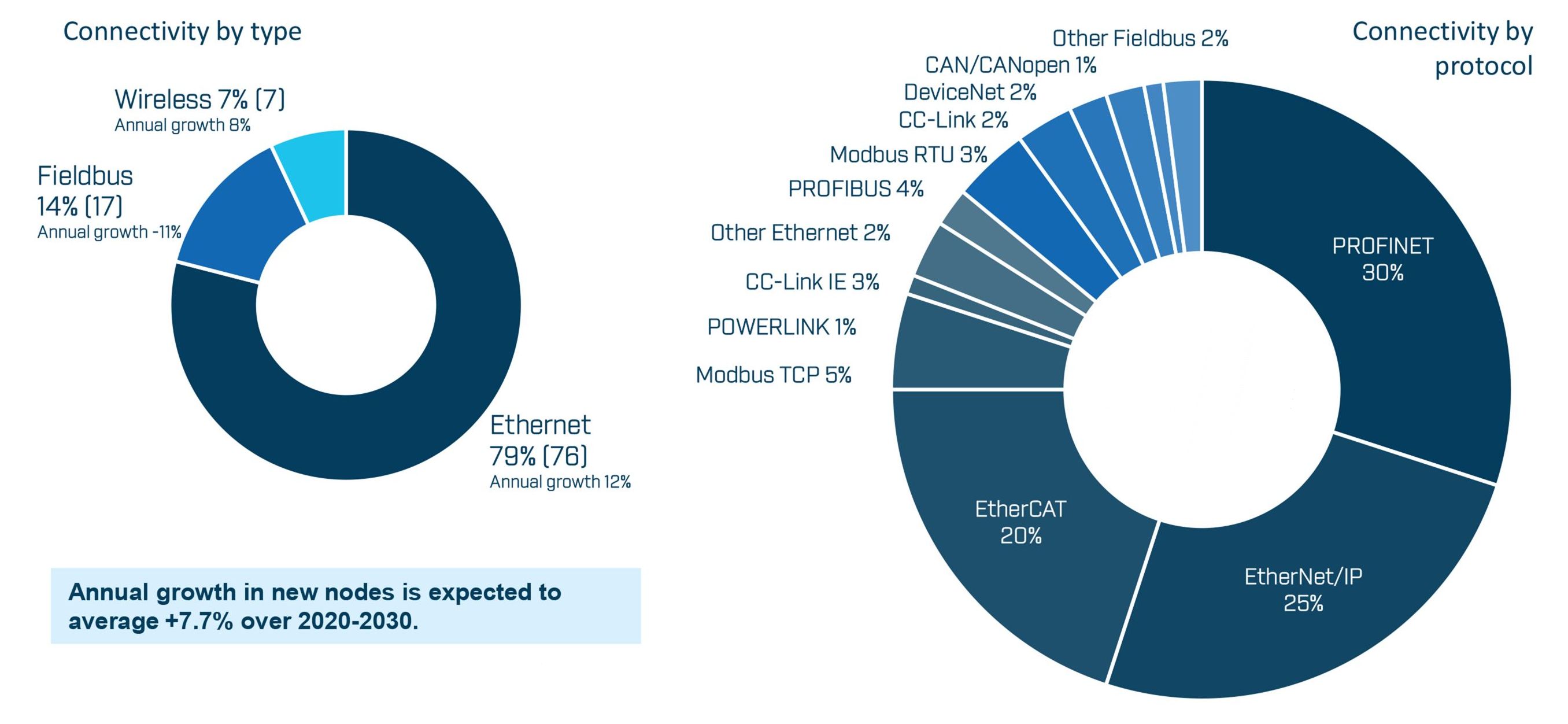
Industrial Ethernet reaches 79% of new installations
The 2026 analysis shows that industrial Ethernet now accounts for 79% of new nodes, up from 76% in 2025. The three leading Ethernet protocols continued to consolidate their position, together representing roughly three-quarters of the wired protocol market.
For the industrial Ethernet protocols:
- Profinet has strengthened its lead at 30% (up from 27%).
- EtherNet/IP followed at 25% (up from 23%).
- EtherCAT continued a strong trajectory at 20% (up from 17%).
- Modbus TCP held steady at 5%.
- CC-Link IE remained stable at 3%.
- POWERLINK declined to 1% (from 3%).
- Other Ethernet protocols account for the remaining 2% as market consolidation around the major networks continues.
Fieldbus drops to 14% as Profibus installations decline
Fieldbus technologies now represent 14% of new nodes, down from 17% in 2025. Profibus & Profinet International’s own published figures showed Profibus new-node installations dropping from 1.1 million in 2024 to 1.0 million in 2025, a 9% decline corroborated by HMS Networks’ internal data and by HMS’s industry survey.
For the major fieldbus protocols:
- Profibus remains the most widely used fieldbus but drops to 4% (from 5%).
- Modbus RTU has held steady at 3%, reflecting its continued role as the universal low-cost serial protocol.
- CC-Link, DeviceNet and CAN/CANopen each remain in the 1–2% range with modest further decline.
- Other Fieldbus protocols collectively account for 2%, down from 4%, as the long tail of legacy networks fades.
Wireless remains steady at 7% utilisation
Wireless technologies continue to connect 7% of new node installations, unchanged from 2025. Wireless retains its established role as a complement to wired industrial networks, particularly valuable for mobile equipment such as AGVs (automated guided vehicles) and AMRs (autonomous mobile robots), retrofitted machinery and IIoT sensors in hard-to-reach locations. 5G remains an area of significant interest but with slow industrial deployment. The complexity of private 5G infrastructure is the most commonly cited barrier. Early industrial 5G deployments continue to grow, particularly in Asia, but the technology has yet to deliver the breakthrough adoption many in the industry expected.
Regional insights
In Europe, Profinet and EtherCAT continue to lead, with strong activity around APL (Advanced Physical Layer) for process automation and SPE (single-pair Ethernet) for sensor-level connectivity. The decline in Profibus is most visible in Europe, where the install base is largest and the migration to Profinet most advanced.
As expected, in North America EtherNet/IP remains the dominant protocol, particularly in automotive and discrete manufacturing. Adoption of IO-Link, APL and SPE is gaining clear momentum, supported by interest in OT cybersecurity ahead of the regulatory landscape taking shape around CRA and IEC 62443.
In Asia Profinet and EtherCAT both continue to grow in the Chinese market. CC-Link IE, the first industrial protocol with TSN mechanism, maintains a strong regional foothold.
What happens next?
“Twelve years of data tell a remarkably consistent story,” said Magnus Jansson, Director of Product Marketing, at HMS Networks. “The migration from fieldbus to industrial Ethernet is now in its later stages, but the more interesting question is what happens next. When nearly everything is Ethernet, the conversation shifts from ‘which protocol?’ to ‘what is running on top of it?’, functional safety, cybersecurity, TSN, OPC UA, single-pair Ethernet, and IT/OT convergence. That is where the complexity — and the differentiation — will increasingly sit.
“The 2026 numbers also reinforce something we have been seeing in our industry survey: cybersecurity is now cited by nearly half of respondents as a top integration challenge, and 93% expect OT cybersecurity to change substantially over the next five years. The protocols matter, but the layers above them increasingly define how factories actually operate.”
Cybersecurity and digitalisation for Zimbabwe platinum mine
An ongoing project with Rockwell Automation technology is supporting the Mimosa mine's...
IEC 62443-3-3 compliance: building a resilient network security foundation
Adopting a systemic view of cybersecurity is the only way to ensure long-term...
Highly precise and safe control of hydrogen testing
With a modular control solution from Beckhoff featuring over 500 data points, Greenlight...