IFR predicts the top five global robotics trends for 2026
The International Federation of Robotics (IFR) reports that the global market value of industrial robot installations has reached an all-time high of US$16.7 billion, and future demand will be driven by a number of technological innovations, market forces and new fields of business.
Below are the top five trends the IFR predicts for the robotics industry in 2026.
1: AI and autonomy
Robots that use artificial intelligence to work independently are becoming more common. The main benefit of AI in this context is increased autonomy. Different types of AI will drive this trend.
Analytical AI helps to process large datasets, detect patterns and provide actionable insights, enabling robots to autonomously anticipate failures before they occur, or for path planning and resource allocation in logistics.
Generative AI, on the other hand, marks a shift from rule-based automation to intelligent, self-evolving systems. GenAI creates new outputs and enables robots to learn new tasks autonomously and generate training data through simulation. This also allows a new kind of human–robot interaction with natural language and vision-based commands.
A key trend to further develop autonomy in robotics is Agentic AI, which also aims to make modern robotics capable of working independently in complex, real-world environments.
2: Greater versatility as IT meets OT
Demand for versatile robots is accelerating, directly reflecting a market push towards a convergence of information technology and operational technology. The merging of IT’s data-processing power and OT’s physical control capabilities can enhance robotic versatility through real-time data exchange, automation and advanced analytics.
This integration is a foundational element of digital enterprise and Industry 4.0.
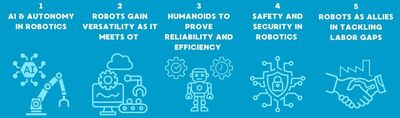
3: Humanoids to prove reliability and efficiency
The field of humanoid robotics is expanding rapidly. Humanoid robots for industrial use are seen as a promising technology where flexibility is required, typically in environments designed for humans. Pioneered by the automotive industry, applications in warehousing and manufacturing are also coming into focus worldwide.
4: Safety and security
As robots increasingly operate alongside humans in factories and service settings, it is essential to ensure they operate safely. AI-driven autonomy fundamentally changes the safety landscape, which makes testing, validation and human oversight much more complex — but also more necessary. This becomes particularly clear in the intended use of humanoid robots. Robotic systems need to be designed and certified in line with ISO safety standards and clearly defined liability frameworks.
In the context of AI in robotics and the convergence of IT and OT, a spectrum of safety and security concerns arise that demand robust governance and clear assignment of liability. The rapid expansion of robotics systems into cloud-connected and AI-driven environments is exposing industrial production to a growing array of cybersecurity threats. The legal and ethical ambiguity surrounding liability has prompted calls for clear frameworks to govern AI deployment.
5: Robots helping to tackle labour gaps
Employers around the world are struggling to find people with the specialised skills they require. These unfilled jobs leave existing staff covering extra shifts, with rising stress and fatigue. A key strategy for addressing this issue is to adopt robotics and automation.
In this transformation process, employers need to keep their human workforce on board. The close cooperation with employees in implementing robots plays a crucial role to ensure acceptance — both in industrial manufacturing settings as well as in manifold service applications. The benefits that robots deliver — taking away routine tasks or opening up new career opportunities — mean that they can be accepted as allies in the workplace. Companies and governments are pushing skilling and upskilling programs to help workers keep up with changing skills demand and to compete in an automation-driven economy.
Industrial robot installations hit five million in 2025: report
Five million robots now operate in factories globally according to the latest report from the...
AutomationFinder launched to take the guesswork out of automation
New initiative gives Australian businesses a practical way to find the right automation...
Robots have a positive effect on employment and productivity: report
The latest IFR position paper on robotics concludes that a comprehensive national robotics...