Solar breakthrough replaces indium with tin
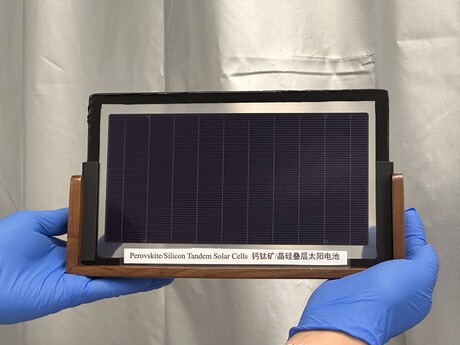
An international Monash University research team says it has built the first high-performance, commercially sized tandem solar cell that doesn't rely on the scarce and expensive metal, indium.
Published in Science, the breakthrough replaces indium-based oxide with abundant tin oxide, a material that costs 1% as much, without sacrificing performance.
The researchers say the advance brings next-generation tandem solar cells a step closer to commercial production, offering the potential for cheaper solar panels that generate more electricity from the same amount of sunlight.
Professor Yuan Cheng from Monash Suzhou and the Department of Materials Science and Engineering at Monash said the milestone marks the first realisation of a large-area, highly efficient indium-free perovskite tandem solar cell, showing that the technology can be scaled beyond laboratory-sized devices.
“Considering the cost of tin is a mere 1% of that of indium, this breakthrough unveils a new material paradigm and a highly viable engineering route for low-cost, sustainable, and scalable tandem photovoltaics,” Professor Cheng said. “Ultimately, this work is of paramount strategic importance for propelling the industrialisation and terawatt-scale deployment of next-generation ultra-high-efficiency photovoltaic technologies.”
As demand for solar energy continues to grow worldwide, reducing reliance on scarce materials is becoming increasingly important. Indium is used in a wide range of electronics, and its limited supply presents challenges for large-scale manufacturing.
By replacing indium with tin oxide using a low-damage reactive plasma deposition process, the researchers created solar cells that achieved a certified efficiency of 31% in a commercially sized mini-module while also improving durability.
The devices also withstood heat, humidity and more than three months of outdoor operation while maintaining strong performance.
Professor Cheng said achieving more than 30% efficiency in a commercially-sized tandem module is a major technical milestone, and demonstrates that high performance can be maintained without relying on scarce, high-cost materials.
The research paper can be found here.
APPEX 2027 to put AI and robotic advances in the spotlight
Being held from 16–19 March 2027 in Melbourne, APPEX 2027 will demonstrate how AI, robotics...
Sparc and Levidian partner on UAE graphene-based coatings manufacturing
Sparc Technologies has entered a partnership for the commercialisation of ecosparc enhanced...
ARC awards $82.5m for new research hubs and training centres
$82.5 million has been awarded in Australian Government funding to 17 new research hubs and...