Research engineers create a better way to boil water
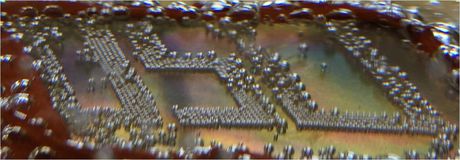
Engineers at Oregon State University have found a new way to induce and control boiling bubble formation that may allow everything from industrial-sized boilers to advanced electronics to work better and last longer. Advances in this technology have been published in Scientific Reports and a patent application has been filed.
The concept could be useful in two ways, researchers say — either to boil water and create steam more readily, like in a boiler or a clothing iron, or with a product such as an electronic device to release heat more readily while working at a cooler temperature.
“One of the key limitations for electronic devices is the heat they generate, and something that helps dissipate that heat will help them operate at faster speeds and prevent failure,” said Chih-hung Chang, a professor of electrical engineering in the OSU College of Engineering. “The more bubbles you can generate, the more cooling you can achieve.
“On the other hand, if you want to create steam at a lower surface temperature, this approach should be very useful in boilers and improve their efficiency. We’ve already shown that it can be done on large surfaces and should be able to scale up in size to commercial use.”
The new approach is based on the use of piezoelectric inkjet printing to create hydrophobic polymer ‘dots’ on a substrate, and then deposit a hydrophilic zinc oxide nanostructure on top of that. The zinc oxide nanostructure only grows in the area without dots. By controlling both the hydrophobic and hydrophilic structure of the material, bubble formation can be precisely controlled and manipulated for the desired goal.
This technology allows researchers to control both boiling and condensation processes, as well as spatial bubble nucleation sites, bubble onset and departure frequency, heat transfer coefficient and critical heat flux for the first time.
In electronics, engineers say this technology may have applications with some types of solar energy, advanced lasers, radars and power electronics — anywhere it’s necessary to dissipate high heat levels.
In industry, a significant possibility is more efficient operation of the steam boilers used to produce electricity in large generating facilities.
First prospective tenants identified for Western Defence Forge
The Government of Western Australia says it has identified five preferred proponents for its...
Automated cell therapy manufacturing system wins Good Design Award
Celleo's Larkem V40 automates one of the last hand-done steps in making a cell therapy...
New wastewater facility opens in Western Sydney
The $1.2 billion Badu Yarragul Water Resource Recovery Facility at Kemps Creek aims to help...