NeoSmelt joins HILT CRC in low-emissions ironmaking research
HILT CRC has announced that the NeoSmelt Joint Venture, one of Australia’s most significant lower-emissions ironmaking initiatives, has joined the research centre, which is working on technologies and processes to shape the future of Australian iron ore and steelmaking.
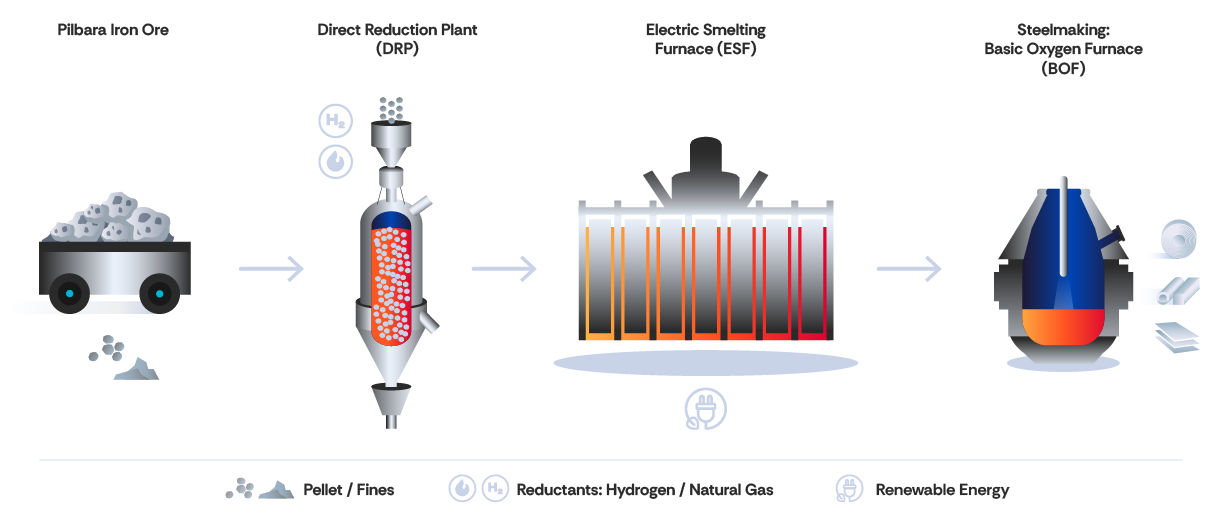
NeoSmelt — a joint venture between BHP, BlueScope, Mitsui Iron Ore Development, Rio Tinto, Woodside Energy and AMB Holdings — is investigating the development of a direct reduced iron electric smelting furnace (DRI-ESF) pilot plant in Western Australia’s Kwinana Industrial Area to demonstrate the use of Pilbara iron ores in an emerging lower-emissions ironmaking process.
Currently in the feasibility phase, the proposed plant would produce around 30,000 to 40,000 tonnes of molten iron annually. It would initially use natural gas in the direct reduction process, with plans to trial hydrogen once operational.
Existing commercial direct reduction processes typically require higher-grade ores than Australia’s abundant Pilbara ores. Successfully demonstrating the DRI-ESF ironmaking pathway will help ensure Pilbara ores remain central to global steel supply chains as the industry decarbonises.
HILT CRC CEO Jenny Selway said NeoSmelt joining as a Key Partner created an important connection between a major pre-commercial demonstration effort and Australia’s research community.
“NeoSmelt brings together organisations spanning iron ore, steelmaking and energy to tackle one of the most important issues facing Australia’s resources sector — ensuring Pilbara iron ores retain a major role in iron and steel production in a decarbonised world,” she said. “Its work to demonstrate DRI-ESF technology using Pilbara ores is closely aligned with HILT’s mission to accelerate and de-risk decarbonisation for heavy industry.
“NeoSmelt joining HILT CRC creates opportunities to connect the lessons from a major industry-led demonstration effort with research into the technologies and processes needed for lower-emissions ironmaking.”
Iron ore remains Australia’s largest export, while iron and steelmaking account for around 8% of global carbon dioxide emissions. Developing viable lower-emissions pathways that work with Australian ores is therefore both a decarbonisation challenge and an important long-term economic opportunity.
As a HILT CRC Key Partner, NeoSmelt will be able to participate directly in collaborative research projects and nominate representatives to HILT CRC’s Research Advisory Committees. This will provide opportunities to contribute to research priorities and connect with expertise across HILT CRC’s network of industry and research partners.
Speaking on behalf of NeoSmelt, Chris Page, General Manager, NeoSmelt and Head of Future Technologies, BlueScope, said joining HILT CRC would complement the joint venture’s work to de-risk and demonstrate lower-emissions ironmaking using Pilbara ores.
“Demonstrating the DRI-ESF pathway for Pilbara ores through the NeoSmelt pilot is a complex technical and commercial project,” he said. “A key part of NeoSmelt’s purpose is to build the knowledge and capability needed to help move this technology towards future commercial deployment. Joining HILT CRC gives us access to a broader network of Australian research and industry expertise, and creates opportunities to collaborate on some of the technical challenges that sit beyond the pilot itself.”
The Western Australian Government has committed $75 million to support NeoSmelt, while the Australian Renewable Energy Agency has committed $19.8 million towards front-end engineering design work. A final investment decision is expected in 2026, with operations currently planned to begin in 2029.
Former mine site at Teralba to be new train manufacturing hub
The NSW Government has announced a former mine site at Teralba as the preferred location for a...
Weld Australia joins Additive Manufacturing CRC
New partnership will connect Australia's welding industry with a $57.5m national research...
APPEX 2027 to put AI and robotic advances in the spotlight
Being held from 16–19 March 2027 in Melbourne, APPEX 2027 will demonstrate how AI, robotics...