Li-S Energy announces Australia’s first lithium foil production line
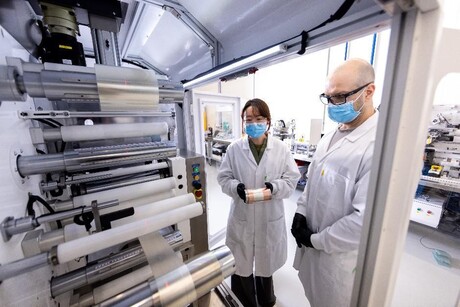
Li-S Energy Limited has announced that it has installed and integrated a new lithium foil roller and laminator into its 2 MWh production facility in Geelong, Victoria, representing a major milestone in the completion of Australia’s first lithium foil production line.
During commissioning, the Li-S Energy team produced Australia’s first 20-micron lithium foils (around one-fifth the thickness of a human hair), and a range of lithium coated copper laminate foils.
Lithium foil is an essential material for lithium sulfur and lithium metal batteries as it is used to make the ultra-high energy density anodes in each cell. The company says the new line will help advances Australia’s sovereign manufacturing capability for critical battery materials, providing LIS with export sales opportunities while ensuring the company has security of supply of lithium foil for its own lithium sulfur and lithium metal battery cell production.
The company also expects to offer a range of Australian produced lithium metal foils and lithium-copper laminates to international customers including research institutions, cell developers and OEMs.
This project has been supported by a $1.78m Industry Growth Program grant, which was instrumental in enabling this new sovereign capability to be developed and delivered.
Work is now underway to enhance the foil production line to automate coating of the company’s Li-nanomesh nanomaterial composites onto lithium foils. This coating is expected to further improve performance, safety and cycle life for advanced battery chemistries, including lithium sulfur.
“Achieving consistent 20 μm lithium foil with integrated rolling, laminating and coating is a major step in capability for Li-S Energy,” said Dr Steve Rowlands, Chief Technology Officer. “Tight thickness control enables us to push Li-S cell energy density and performance while accelerating design-for-manufacture at scale. We can now iterate cell designs faster with customers and deliver production-grade materials to other development programs around the world.”
NeoSmelt joins HILT CRC in low-emissions ironmaking research
NeoSmelt is investigating the development of a direct reduced iron electric smelting furnace...
Former mine site at Teralba to be new train manufacturing hub
The NSW Government has announced a former mine site at Teralba as the preferred location for a...
Weld Australia joins Additive Manufacturing CRC
New partnership will connect Australia's welding industry with a $57.5m national research...