JCU develops 'world first' bendable ceramic
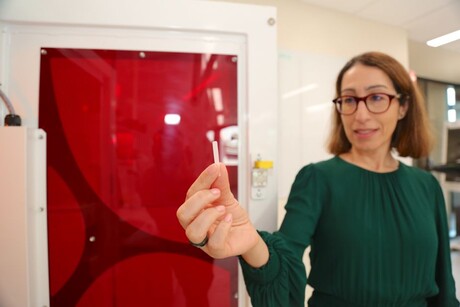
James Cook University has announced that its engineers have developed a groundbreaking bendable ceramic material that could revolutionise aerospace design.
Lockheed Martin will join forces with JCU project lead Dr Elsa Antunes and her team over the next year to stress test a 3D-printed bendable ceramic material that can withstand being flexed thousands of times before showing signs of fatigue.
“These are the ceramics that can take you above Mach 5, which is getting into hypersonic territory,” Antunes said. “We are able to combine technologies by simultaneously producing complex shapes with ceramics that are bendable and have an extended lifetime and be able to withstand extremely high temperatures that are required for aerospace.
“This opens up a whole new field of applications in aerospace, creating new opportunities in the industry.”
Traditional ceramics are often used in aircraft and spacecraft because of their ability to withstand high temperatures in extreme environments, but are prone to cracking due to their brittle nature.
While bendable ceramics are not new, the JCU team has been able to design a prototype of varying thickness with a flexural strength (resistance to breaking) of around 1.7 GPa that is capable of withstanding more than 10,000 loading cycles without breaking — a feat no manufacturer has been able to achieve.
“Even if we applied 80% of that maximum load, what we found is that after 10,000 cycles, the part did not break,” Antunes said. “A normal ceramic material available on the market can take only 20% of that load before it will break.”
As part of the project, the JCU team will 3D print special ceramic parts that could theoretically be used in aircraft for thermal management, and then expose those parts to extreme temperatures and forces to test their resilience.
Antunes said an added advantage was that bendable ceramic materials could be produced within just seven days compared to traditional composite ‘ceramic matrix’ materials, which can take at least a month to fabricate and lack the same flexible properties.
“On top of this, we are able to produce ceramics with complex structures and shapes that are otherwise not possible with traditional ceramic matrix manufacturing,” she said.
JCU’s design would allow a ceramic compound to flex with an aircraft surface, such as a wing, reducing the risk of cracking and allowing greater forces to be applied when testing high-performance vehicles.
Antunes said the new partnership would put JCU and northern Queensland on the map as a hub for developing advanced aerospace technologies.
“Advanced manufacturing is a priority for the government, and our students are very motivated to work on projects like this,” she said.
NeoSmelt joins HILT CRC in low-emissions ironmaking research
NeoSmelt is investigating the development of a direct reduced iron electric smelting furnace...
Former mine site at Teralba to be new train manufacturing hub
The NSW Government has announced a former mine site at Teralba as the preferred location for a...
Weld Australia joins Additive Manufacturing CRC
New partnership will connect Australia's welding industry with a $57.5m national research...