Inaugural scholarships to support future heavy industry decarbonisation
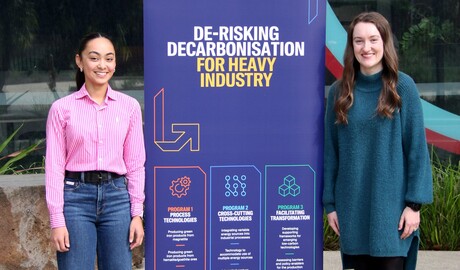
Two Adelaide University engineering students have been awarded the inaugural HILT CRC–Adelaide University Undergraduate Scholarships, supporting the next generation of engineers to contribute to the decarbonisation of heavy industry.
The scholarships were established by The Heavy Industry Low-carbon Transition Cooperative Research Centre (HILT CRC) and Adelaide University to support undergraduate coursework students in Chemical Engineering, Mechanical Engineering, Electrical/Electronic Engineering and Mining and Mineral Engineering.
The 2026 recipients are Juliana Lanzilli and Robyn Dolphin, who will each receive $15,000 over two years, as well as opportunities to attend HILT CRC events and engage with HILT partner organisations working across Australia’s low-carbon heavy industry transition.
HILT CRC Chief Executive Officer Jenny Selway said the scholarships were designed to connect talented students with the industries and researchers working on practical solutions for hard-to-abate sectors.
“Robyn and Juliana are joining a national effort to build the skills, knowledge and industry connections needed for heavy industry’s transition to net zero,” she said. “South Australia — particularly through Adelaide University — has deep expertise in engineering, energy and industrial innovation, and partnerships like this help ensure students can see a direct pathway from their studies into work that has real-world impact.”
Adelaide University’s Professor Yan Jiao, Dean of the School of Chemical Engineering, said the scholarships reflected the importance of equipping engineering students to contribute to one of the defining industrial challenges of the coming decades.
“These scholarships recognise students who have shown strong academic performance, clear motivation and a genuine interest in supporting the transition to low-carbon heavy industry,” Jiao said. “By working with HILT CRC, Adelaide University is helping students connect their technical education with the practical needs of sectors such as steel, minerals processing, energy and manufacturing.”
Dolphin said the scholarship would help her build the skills and networks needed to contribute to lower-emissions industry.
“I’m grateful for the opportunity this scholarship provides to connect my studies with the real challenges facing heavy industry,” she said. “It is encouraging to know that students are being supported to contribute to practical solutions for decarbonisation, and I’m looking forward to learning from researchers and industry partners through HILT CRC.”
Lanzilli said the scholarship would strengthen her ability to pursue engineering work with environmental and industrial impact.
“The transition to low-carbon industry will require engineers who can work across technical, economic and environmental challenges,” she said. “This scholarship gives me the chance to deepen my understanding of those challenges and to engage with people who are already developing solutions for Australia’s heavy industries.”
ARENA opens Round 3 of Solar Sunshot with $250m available
ARENA is seeking local and global solar innovators for the latest $250 million solar...
CCEP's $39.7m can line upgrade in Perth increases capacity 40%
The investment at Coca-Cola Europacific Partners' Kewdale facility lifts speeds to...
ARENA funds manufacturing of solar construction robots
Australian-made solar robots are moving towards commercial scale with $31.1m in ARENA funding.