UNSW engineers awarded grant for critical renewables research
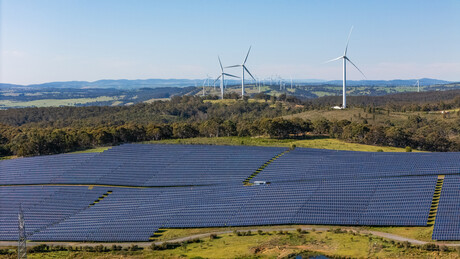
The UNSW School of Electrical Engineering and Telecommunications and the Real Time Simulations Laboratory (RTS@UNSW) have announced they will undertake a three-and-a-half-year project to test crucial elements related to the safety and storage of renewable energy with the help of a $6.52 million grant from the Australian Renewable Energy Agency (ARENA).
UNSW Sydney Associate Professor in Energy Systems Georgios Konstantinou said the project — titled 'Protection & Relay Operation for Inverter-based Low-inertia Electricity Systems' or PROFILES — will examine and test problems and solutions in inverter-based resources, which are the systems used by solar, wind and battery storage.
“The way that the power is supplied from renewables is fundamentally different to that of traditional coal fired generation,” Konstantinou said. “This work will help to future proof, manage risks and reduce the costs associated with renewable power systems.
“It will be a continuous process of informing both industry and the research community about problems and solutions with inverter-based resources (solar, wind, batteries), their fault current contributions and power system protection.”
ARENA said, as more inverter-based resources connect to the National Electricity Market (NEM), maintaining system security requires a clearer understanding of how emerging technologies could provide system strength.
“AEMO’s Transition Plan for System Security identifies minimum system strength provision from grid-forming battery energy storage systems as one of the key areas requiring further evidence,” it said in a statement. “The project responds to this need by examining how grid-forming batteries interact with protection systems when providing fault current, a technical question that must be better understood before these systems can be relied on more widely for system strength services.”
ARENA said UNSW is well placed to lead the work because of its ‘hardware-in-the-loop capability’ and its independence as a research organisation, which should help ensure the findings are useful and credible across the industry.
The project also includes contributions from industry partners from Australia’s largest electricity network, Transgrid, AEMO and ElectraNet, which operates South Australia’s electricity transmission network, Power Electronics, SMA, Tesla and Siemens, and will run until November 2030.
First prospective tenants identified for Western Defence Forge
The Government of Western Australia says it has identified five preferred proponents for its...
Automated cell therapy manufacturing system wins Good Design Award
Celleo's Larkem V40 automates one of the last hand-done steps in making a cell therapy...
New wastewater facility opens in Western Sydney
The $1.2 billion Badu Yarragul Water Resource Recovery Facility at Kemps Creek aims to help...